The processing of a single bank statement isn’t much of an operational difficulty. With only one PDF document is being processed it’s even a manual entry feasible.
Now spread that work out across numerous businesses, a number of bank accounts, and a variety of statement periods.
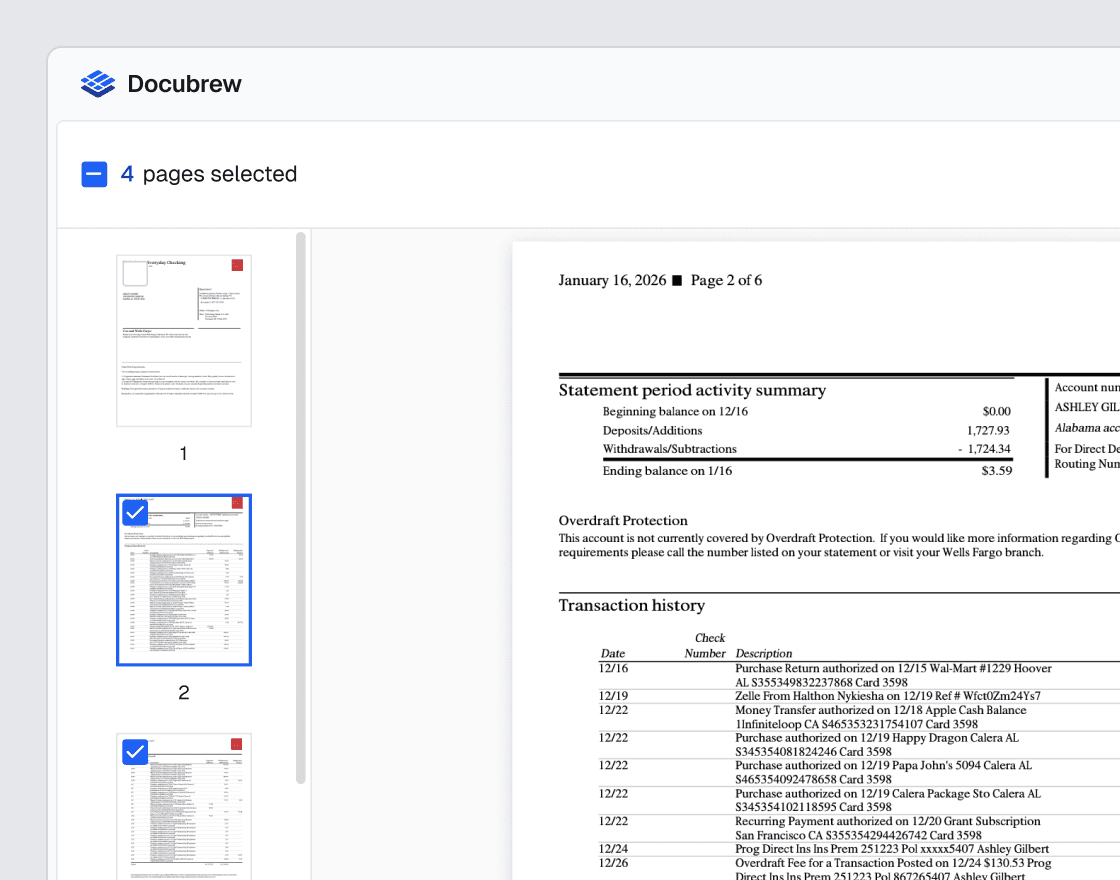
Image credit: docubrew.com
The problem is not the same. Once, it was a simple job for a clerical worker, but now it’s a lengthy process that consumes staff time and increases the chances of unreliable data entry. It’s not only about speeding up the conversion of bank statements for accounting and bookkeeping firms. It’s about developing a process that can still work when volume increases.
The problem is in repetition.
Imagine that an accounting company receives PDFs every month from multiple clients. One client is sending statements from Chase One client is Wells Fargo, the other Wells Fargo and others Bank of America, Capital One or Citi.
Download each PDF file, then manually enter every transaction manually.
A converter for bank statements can move the flow of work from transcription to review. Docubrew analyzes the actual bank statement to obtain transaction data, instead of estimating values. This creates structured files which can be reviewed before use. With the increase in document volume this distinction becomes more important.
Batch Processing Modifies Equation
A separate handling of files is appropriate for occasionally needed conversions. Accounting firms usually have to deal with a different set of challenges. Docubrew lets multiple documents to be uploaded and processed in a single batch, with distinct results. The company can process an abundance of documents provided by clients without needing to manually create every transaction table.
If the accounting workflow requires CSV files, users can convert bank statements to CSV and review the resulting transaction data before moving forward.
Scanned paper statement do not have to be excluded. Docubrew includes OCR for PDFs that have been scanned, which can be helpful if a client’s historical records include documents that are native PDFs and scanned files.
Create outputs to support the accounting work in the future.
It’s not the end of the procedure. The transaction must be delivered to a destination.
Docubrew supports exporting CSV, Excel and QBO. QBO is a choice for a team to export a bank account to Quickbooks. Also, it is available in the general spreadsheet format.
Businesses that convert bank statements into Quickbooks regularly can set up a routine for receiving the statements after processing them, as well as checking the extracted data. They also can prepare the documents needed to help the accounting process.
Human review still matters. Automated transcription can reduce repetitive transcription, but bookkeepers are still responsible for reviewing financial data and completing the accounting process properly.
Client data should be the subject of its own workflow decisions
A higher volume of documents also implies handling more sensitive client information.
Docubrew uses two methods of processing. Windows desktop software can convert files locally and lets them remain on the computer of the company. Docubrew says that cloud uploads are secure and uploaded files and converted files are automatically deleted after 24 hours.
Accounting practices are able to choose the most effective method for their internal handling requirements.
Scale the process, not the repetitive work
The increasing use of bookkeeping procedures should result in more financial documents. It shouldn’t automatically be able to accept the need for more copy-and-pasting.
It is crucial to inquire whether the process that was successful for five clients could be applied to 50.
The way that statements are received, evaluated and prepared for accounting software can aid firms in creating a workflow that can handle recurring volumes, rather than treating each PDF as an individual manual project.